ABC Scottish Bagpipe Fingering Player Instructions
Overview
Load, type, or paste ABC tunes and play them with synchronized standard notation and an optional Great Highland bagpipe tablature display.
The Bagpipe Fingering pane shows the current tune title and, during playback, a large fingering diagram for the note being played with its note name to the right.
Use Notation display to choose standard notation alone or standard notation with Highland bagpipe tablature. The default is Notation + Bagpipe Tab.
Opening and Selecting Tunes
Type or paste a single tune into the ABC editor, open an .abc or .txt file containing one or more tunes, import a .bww Bagpipe Music Writer or Bagpipe Reader file, or send tunes directly from ABC Transcription Tools.
For multi-tune files, use the Tune menu to select the tune to display and play. Edits are retained when changing tunes.
The ABC editor intentionally accepts only one pasted tune at a time; multi-tune collections should be opened as a file or transferred from ABC Transcription Tools.
ABC Editing and Notation
The upper-left panel contains editable ABC. The lower-left panel shows abcjs notation and playback controls. The Notation display selector chooses whether Highland bagpipe tablature is also shown.
Editing the ABC rebuilds the notation and audio. When bagpipe tablature is enabled it is rebuilt at the same time. Click a rendered note to select its corresponding ABC text and show that note in the fingering display.
The Small / Medium / Large / Largest selector changes the ABC editor text size and remembers the choice in this browser.
Click on any note head in the notation and then use ← and → below the instrument display to step through the notes without playback.
Leave Use arrow keys? checked at the lower right of the instrument panel to navigate with the Left and Right Arrow keys, or jump to the first or last note with Home or End (including compatible Bluetooth keyboard foot pedals).
This option is on by default. Your choice is remembered in this browser, including when you open a shared tune or run a lesson. Share and lesson links do not change this setting.
When enabled, unmodified Left and Right Arrow keys step through notes, and Home and End jump to the first and last notes of the tune.
These keys navigate notes instead of moving the ABC editor cursor.
Keyboard shortcuts are temporarily disabled while dialogs or controls that use these keys are active. When this option is enabled, the shortcuts also work while the ABC editor has focus.
Uncheck the option to restore normal arrow-key behavior.
Playback Range
Select one or more notes in the ABC editor, or click a note in the rendered notation to select it.
The previous and next note buttons can also select notes without rebuilding the player until you click Set Playback Range.
The Set Playback Range button in the ABC editor header becomes available when your selection includes notes.
Restore becomes available whenever a playback range or Phrase Builder result is active.
Click Set Playback Range to temporarily replace the visible ABC, notation, and audio with the selected passage while retaining the tune's complete header and preceding comments, directives, and ABC fields.
Any part of the selection within the tune header is ignored.
Use the normal Play and Loop controls to practice just that passage.
To narrow the passage further, select notes within the currently displayed range and click Set Playback Range again.
You can repeat this process to create smaller nested playback ranges without changing the preserved original tune.
You can edit the temporary ABC while a range is active, and its notation and audio will update as you type.
Any changes you make to the ABC within a playback range are temporary and are not saved when the full tune is restored.
Click Restore to discard temporary Playback Range or Phrase Builder edits and restore the entire original tune, not just the previous range.
Saving ABC, creating share or lesson links, and opening tunes in ABC Transcription Tools always use the preserved full tune rather than the temporary range.
Clicking the main Export PDF button automatically discards any temporary Playback Range or Phrase Builder result and restores the full tune before preparing the PDF.
Changing tunes or loading another ABC file also discards any temporary Playback Range or Phrase Builder result and its edits.
Changing chanter pitch clears the playback range and discards temporary edits.
Phrase Builder
Phrase Builder creates a temporary call-and-response practice version of the ABC currently shown.
Choose the phrase length, extra rest measures, and number of times to repeat each phrase.
Your Phrase Builder settings are saved in this browser and are not included in share or lesson links.
Chord symbols are removed from the result.
You can first use Set Playback Range to select part of a tune, then use Phrase Builder on that passage.
After building phrases, Phrase Builder is disabled until you click Restore.
You can still use Set Playback Range as many times as you like on the phrase-built ABC.
Restore discards all temporary changes and brings back the complete original tune.
Saving, sharing, creating lessons, and opening a tune in ABC Transcription Tools always use the original tune.
Changing tunes or using the main Export PDF also restores the original ABC.
Phrase Builder cannot process tunes with V: voices or unsupported body-level ABC fields other than K:.
Cancelling Phrase Builder or entering invalid settings leaves the ABC unchanged.
Bagpipe Fingering Display
The display uses standard bagpipe fingering. The note name appears to the right of the fingering symbol.
Check Show note to also show the current pitch as a quarter note on a staff just below the note name. The Show note setting is remembered in this browser and is not included in share links.
The traditional chanter note names C and F correspond to sounding C-sharp and F-sharp. K:HP uses the Highland A Mixolydian scale (C-sharp and F-sharp) while showing no key-signature sharps; the fingering display and playback still use the sharpened pitches. The optional staff note displays the written pitch according to the tune key.
Check Hide to clear the instrument display; it can be used if you want to practice a tune without seeing the instrument fingerings. Uncheck Hide to reveal the display again. This setting is remembered during normal use and can be changed without saving during a lesson.
Note names use uppercase letters with apostrophes for the upper octave (for example G' and A').
All fingering glyphs are black; no octave color coding is applied.
The Notation display and Chanter pitch choices are remembered in this browser and included in generated share links.
Playback and Tempo
The playback Loop setting is remembered in this browser and restored when you reopen the player (off by default).
As each melody note plays, the notation cursor follows the tune and the Bagpipe Fingering pane updates to that note.
For Highland chanter pitches, playback uses MIDI program 109. The Smallpipes in D and Smallpipes in A options use MIDI programs 130 and 131, respectively.
Show graces in the Notation header controls whether the small grace notes receive bagpipe fingering symbols. It is checked by default and remembered on this device. Unchecking it hides only the grace fingering symbols: the written grace notes and playback are unchanged, and PDF exports follow the current setting.
Check Metronome to add a meter-appropriate metronome click during playback. Changing this setting stops and rewinds the current tune. The metronome setting is remembered in this browser but is not included in share links.
Check Count in? to show a five-second countdown before playback starts when you click Play while playback is stopped.
The Count in setting is remembered in this browser.
Click Mute Melody in the Notation header to mute the bagpipe melody. This is available for every tune, including tunes without chord symbols, so you can practice with the metronome alone. If the tune contains chord symbols, chord and bass accompaniment remain audible.
Toggling Mute Melody or Unmute Melody stops and rewinds the tune. If it was playing, playback restarts from the beginning after the five-second count-in when Count in? is enabled, or immediately when Count in is disabled. If the tune was stopped, it remains stopped.
The button changes to Unmute Melody; click it again to restore the bagpipe melody.
The melody always starts unmuted when the tool is opened, and the mute setting resets to unmuted any time you change tunes or load a new tune collection.
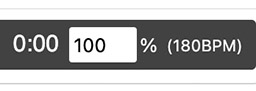
Click Tempo in the Notation header to set playback tempo from 10% to 200% of the tune's original tempo. The value is remembered in this browser.
You can also click the tempo percentage box on the playback control bar:
Resizing and Full-Page View
On wide screens, drag the vertical divider to resize the left and bagpipe-fingering panes, and drag the horizontal divider to resize the ABC and notation panes. Double-click a divider to reset it.
Click Full-Page View on the ABC, Notation, or Bagpipe Fingering pane to expand it to the full browser window. Click Exit Full-Page to return to the normal pane view.
Click Save to save the complete currently loaded tune collection, including edits and tunes converted from BWW. Saved files contain ABC, not BWW. On mobile devices the saved file uses a .txt extension. On iPhone and iPad, choose a destination from the native share sheet (for example, Save to Files).
Share opens the Sharing Controls dialog. Choose Share Current Tune for the current tune or Share All Tunes for the complete loaded collection. The Sharing Controls dialog closes and the selected link opens in a Share Link dialog where you can copy it, save it as a text file, test it in a new browser tab, or open the ABC in the ABC Transcription Tools. Click Close to close the Share Link dialog.
Shortcut: Option/Alt-click Share to open the current tune directly in ABC Transcription Tools in a new browser tab, without opening the sharing dialogs.
Open in ABCTT opens the selected ABC in the ABC Transcription Tools ABC Editor in a new browser tab, using the player's normal instrument-specific conversion settings. For a Lesson Share Link, lesson-only information is omitted and only the tune and applicable instrument settings are sent to ABC Transcription Tools.
Settings received from a share link are used for that visit without changing your saved preferences. If you change any player setting, the current share-link settings become your saved preferences too. Opening a file with Browse loads its ABC only and does not change player settings.
When ABC arrives through a share link or direct transfer, click Click to Enable Playback if the browser requires a user gesture before audio can start.
Practice with the ABC Transcription Tools Tune Trainer
To practice the current tune in the ABC Transcription Tools, first click Share in this player, choose Share Current Tune, and then click Open in ABCTT in the Share Link dialog. The tune opens in the ABC Transcription Tools in a new browser tab. Alternatively, Option/Alt-click Share to open the current tune directly in ABC Transcription Tools, skipping the Share dialogs.
Once the tune is loaded, click Train above the ABC editor pane to start the Tune Trainer. To practice the tune phrase-by-phrase, click Phrase Builder in the Tune Trainer.
To export an MP3 audio file of the tune, click Play in the ABC Transcription Tools, then click the Export Audio, Image, or PDF button in its Player and select the MP3 audio export option.
Highland Bagpipe and Smallpipes Pitch and Range
The Highland bagpipe chanter has nine standard fingerings, from G4 through A5. C and F in the traditional scale sound as C-sharp and F-sharp. Notes outside the standard fingering set display x.
Choose the instrument and pitch using Chanter pitch. The default is A=454 Hz for practice chanters. The Highland choices A=440, 454, 466, and 480 Hz use %%MIDI program 109 with the same %voice_tuning_cents offsets as ABC Transcription Tools' Inject Bagpipe Sounds feature.
The two Smallpipes choices are separated from the Highland pitches in the dropdown: A=440 Hz (Smallpipes in A) and D=293.66 Hz (Smallpipes in D). Smallpipes in A uses %%MIDI program 131, while Smallpipes in D uses %%MIDI program 130.
The selected Highland or Smallpipes option is remembered in this browser and included in tune share links, lesson share links, and saved lesson configurations. When you open a tune or an entire tunebook in ABC Transcription Tools, the player's selected program and playback tuning or transposition are included for each transferred tune. These playback directives do not modify the editable ABC in this player.
All pitch choices affect playback only and never modify the editable ABC or saved ABC files. The selected choice is remembered locally and included in tune share links and lesson settings. The PDF title's link to ABC Transcription Tools also carries the selected sound and transposition.
Fingering diagrams use Clint Goss's WARBL Font Folio, licensed under the SIL Open Font License 1.1.
Export PDF
Use Export PDF to save the current tune as a PDF containing the notation and any displayed tablature.
If a Playback Range or Phrase Builder result is active, clicking the main Export PDF button first discards the temporary ABC and restores the full tune before preparing the PDF.
In PDFs exported from this main Export PDF button, the tune title is a clickable link that opens the tune in the ABC Transcription Tools Player. The link uses the same tune transfer as Current Tune Share Link > Open in ABCTT, but opens the Player rather than the Editor.
Choose Letter or A4 paper and Portrait or Landscape orientation.
By default, the PDF includes a centered Click the title to play instruction in the top margin of its first page. Uncheck Add "Click the title to play" on the first page header to omit this instruction; the tune title remains clickable, and the title and music do not move.
Each complete staff/tablature system stays together. When a short tune only slightly exceeds one page, the PDF may scale the notation down a little to keep it on one page; longer tunes paginate normally.
For multipage tunes, page numbers appear centered at the bottom of each page.
A status dialog shows progress while the PDF is generated. On iPhone and iPad, PDF saving uses the native share sheet, as do saved ABC files, share-link text files, and lesson configuration files.
On an iPhone or iPad, tap Save PDF when the file is ready to open the iOS share sheet.
Choose Save to Files or another destination from that sheet.
On other devices, the PDF downloads automatically.
PDF export settings are saved locally and are not included in share or lesson links.
Printing Limitations
While running this tool, you can use your browser's Print feature to print the music notation displayed in the notation pane.
Tunes that are longer than one page may be cut off or clipped in the printout.
The browser's print scaling controls will not affect the size of the printed notation.
Experimenting with other paper sizes, such as Tabloid instead of Letter, may allow a longer tune to fit on a single page.
Manually setting larger left and right margins in the browser's Print dialog can often allow more staves to fit on a single page or possibly help with cleaner pagination.
Lesson Information for Music Teachers
Share opens the Sharing Controls dialog. Choose Configure Lesson… to create, edit, save, load, or share a lesson for your students.
A lesson uses the current tune only.
Enter a lesson title and instructions in the Configure Lesson dialog.
The lesson title and instructions are remembered in this browser while you work and are restored the next time you open Configure Lesson.
Save Lesson Configuration saves a reusable text file containing the current tune, lesson title, instructions, and the same player settings carried by a normal Scottish Bagpipe Player share link.
Load Lesson Configuration can open either a saved Lesson Configuration file or a Lesson Link saved as a text file.
Those saved player settings are Notation display and Chanter pitch.
You can also open a saved Lesson Configuration with the main ABC/BWW file Browse button. In this case, only the ABC tune is loaded; the lesson title, instructions, and saved player settings are not applied.
If one or more tunes are already loaded, the tool asks for confirmation before replacing them with the lesson tune.
Loading a lesson configuration restores its tune, lesson title, instructions, and player settings for the current session without changing your permanently saved Notation display or Chanter pitch preferences. If you subsequently change either setting normally, your new choice is saved.
Create Lesson Link creates a share link for the current tune containing the lesson title and instructions plus the same player settings carried by a normal share link.
The generated lesson link opens in the same Share Link dialog, stacked over the Configure Lesson dialog, where it can be copied to the clipboard, saved as a text file, tested in a new browser tab, or opened in the ABC Transcription Tools with lesson-only parameters removed. Click Back to close the Lesson Share Link dialog and return to Configure Lesson.
The Hide checkbox beside Show note lets you prepare a lesson with the instrument display initially hidden, so students can practice without seeing the instrument fingerings. Its checked or unchecked state is included in Lesson Links and saved Lesson Configurations. Students can change Hide during the lesson.
Lesson Information for Students
Your music teacher may provide you with a Scottish Bagpipe Player lesson link.
Open the lesson link in your web browser to load the tune, lesson instructions, and the player settings chosen by your teacher.
Read the lesson information that appears, then click Start Lesson when you are ready to begin.
After clicking Start Lesson, click Click to Enable Playback to enable the audio playback controls.
The lesson setup controls and the lesson tune selector are shown at the top of the player but are initially disabled so the teacher's lesson setup cannot be changed.
The Browse and Save controls remain available while you are using a lesson, but the Share control is hidden so you cannot create share links or lessons.
You can use the normal notation, fingering display, playback, tempo, metronome, count-in, display, and full-page controls while working on the lesson.
You can edit the ABC if your teacher asks you to make changes.
Click Save to save your edited ABC.
You can use Browse to load a saved ABC file back into the player or open another ABC file. The lesson's player settings remain locked. After you load an ABC file, the tune selector is unlocked so you can select any tune in that file.
The Hide checkbox beside Show note may be initially checked by your teacher to let you practice without seeing the instrument fingerings. Uncheck Hide whenever you want to reveal the instrument display, or check it again to practice without it. Changing Hide during a lesson does not change your saved preference for normal player use.
About
This tool was created by Michael Eskin
If you find it useful, please consider a contribution via
Support Michael Eskin's Music Tools