ABC Irish Button Box Fingering Player Instructions
Overview
Load, type, or paste ABC tunes and play the tunes with synchronized standard notation and Irish button accordion fingerings.
Choose B/C or C#/D tuning. The fixed 21-button keyboard diagram shows the C row above the B row for B/C tuning, and the D row above the C# row for C#/D tuning.
23-button instrument players will need to offset the displayed button position one button to the right.
The fingering solution uses the same B/C and C#/D tablature solution as ABC Transcription Tools.
Play tunes with synchronized notation highlighting and a button diagram that shows the required button and Push or Draw direction.
Edit the ABC directly and click rendered notes to locate them in the editor and show their button fingering without starting playback.
Load and work with multi-tune ABC collections, save your edited ABC, and create share links for one tune or the complete collection.
Use the resizable workspace and optional full-page button diagram for practice on desktop and mobile browsers.
Opening and Selecting Tunes
You can start by typing or pasting a single tune directly into the ABC text area, open an ABC file containing one or more tunes, or send a set of tunes directly from ABC Transcription Tools.
If more than one tune is loaded from a file, share link, or direct transfer, choose the tune from the Tune menu.
The ABC text area accepts only one tune at a time when pasting.
If a paste would put multiple tunes in the editor, the paste is not performed and a message asks you to save the tunes to a .abc file and load that file into the tool instead.
If you have unsaved ABC changes and choose a new ABC file, the tool warns that the existing work will be lost and asks you to confirm before the new file is opened.
Button Box Tuning and Display
Select the Tuning as B/C or C#/D.
For B/C, the top row of the diagram is the C row and the bottom row is the B row. For C#/D, the top row is the D row and the bottom row is the C# row.
Each button is divided into Push and Draw halves and displays the corresponding note names. During playback or when a note is clicked, the top half lights red for Push and the bottom half lights green for Draw.
A matching arrow centered below the button board shows the bellows direction: a red downward arrow indicates Push and a green upward arrow indicates Draw.
The selected tuning is remembered in this browser.
ABC Editing, Notation, and Button Display
The upper-left panel contains editable ABC and the lower-left panel shows the rendered notation and playback controls.
Editing the ABC rebuilds the notation, audio, and button solution.
Click a note head in the rendered notation to highlight it in red, select its associated note in the ABC editor, and immediately show that note's button and Push/Draw direction on the main Button Diagram without starting playback.
The complete ABC note token is selected, making it easy to replace the complete note.
The Small / Medium / Large / Largest selector changes the ABC editor text size.
Medium is the default, and the selection is saved in this browser.
Resizing the Panels
On wide screens you can drag the divider between the left and right sides to resize the ABC/notation area and button diagram.
Drag the divider between the ABC and notation panels to resize those two panels independently.
Double-click either divider to restore that divider to its original default position.
The divider positions are remembered in this browser and restored the next time the tool is opened on a wide screen.
Playback and Tempo
As each melody note plays, the notation cursor follows the tune and the button diagram highlights the required accordion button and bellows direction.
Red indicates Push and green indicates Draw.
Note names throughout the tool use sharps or flats according to the tune's K: key and mode.
Check Show note in the Button Diagram header to also show the current pitch as a quarter note on a staff positioned to the right of the button board. The Show note setting is remembered in this browser and is off by default until you enable it.
The staff notation uses the same sharp or flat naming as the displayed note name.
Check Metronome to add a meter-appropriate metronome click during playback. Changing this setting stops and rewinds the current tune. The metronome setting is remembered in this browser but is not included in share links.
Check Count in? to show a five-second countdown before playback starts when you click Play while playback is stopped.
The Count in setting is remembered in this browser.
Click Mute Melody in the Notation header to mute the button accordion melody. This is available for every tune, including tunes without chord symbols, so you can practice with the metronome alone. If the tune contains chord symbols, chord and bass accompaniment remain audible.
Toggling Mute Melody or Unmute Melody stops and rewinds the tune. If it was playing, playback restarts from the beginning after the five-second count-in when Count in? is enabled, or immediately when Count in is disabled. If the tune was stopped, it remains stopped.
The button changes to Unmute Melody; click it again to restore the button accordion melody.
The melody always starts unmuted when the tool is opened, and the mute setting resets to unmuted any time you change tunes or load a new tune collection.
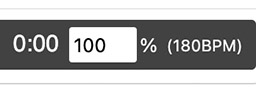
Click Tempo in the Notation header to set playback tempo from 10% to 200% of the tune's original tempo. The value is remembered in this browser.
You can also click the tempo percentage box on the playback control bar:
Resizing and Full-Page View
On wide screens, drag the vertical divider to resize the left and button-diagram panes, and drag the horizontal divider to resize the ABC and notation panes. Double-click a divider to reset it.
Click Full-Page View on the ABC, Notation, or Button Diagram pane to expand it to the full browser window. Click Exit Full-Page to return to the normal pane view.
Saving the ABC
Click Save to save the entire currently loaded tune collection, including edits made to any tune.
Edits are retained when you change tunes with the Tune menu.
On mobile devices, the file is saved with a .txt extension.
Share opens the Sharing Controls dialog. Choose Share Current Tune to create a share link for the currently displayed tune, or Share All Tunes to create a share link containing all loaded tunes.
The Sharing Controls dialog closes and the selected link opens in a Share Link dialog where you can copy it, save it as a text file, test it in a new browser tab, or open the ABC in the ABC Transcription Tools. Click Close to close the Share Link dialog.
The link includes the current B/C or C#/D tuning.
Open in ABCTT opens the selected ABC in the ABC Transcription Tools ABC Editor in a new browser tab using the player's corresponding Irish button accordion conversion settings. For a Lesson Share Link, lesson-only information is omitted and only the tune and applicable instrument settings are sent to ABC Transcription Tools.
A share button is disabled when its resulting link would exceed the maximum allowed of 8100 characters.
Opening a share link restores its B/C or C#/D tuning and displays the first tune encoded in the link.
Settings received from a share link are used for that visit without changing your saved preferences. If you change the tuning, the current share-link setting becomes your saved preference too. Opening a file with Browse loads its ABC only and does not change player settings.
When tunes are opened from a share link or transferred directly from ABC Transcription Tools, click the Click to Enable Playback button in the playback area before using the normal playback controls.
This user action allows audio playback to be initialized on browsers that require a user gesture before starting audio.
ABC Chord Symbols
Quoted ABC chord symbols are ignored by the fingering solver but remain available to abcjs for accompaniment.
Lesson Information for Music Teachers
Share opens the Sharing Controls dialog. Choose Configure Lesson… to create, edit, save, load, or share a lesson for your students.
A lesson uses the current tune only.
Enter a lesson title and instructions in the Configure Lesson dialog.
The lesson title and instructions are remembered in this browser while you work and are restored the next time you open Configure Lesson.
Save Lesson Configuration saves a reusable text file containing the current tune, lesson title, instructions, and the same player setting carried by a normal Irish Button Box Player share link.
Load Lesson Configuration can open either a saved Lesson Configuration file or a Lesson Link saved as a text file.
The saved player setting is the selected B/C or C#/D tuning.
You can also open a saved Lesson Configuration with the main ABC file Browse button. In this case, only the ABC tune is loaded; the lesson title, instructions, and saved player setting are not applied.
If one or more tunes are already loaded, the tool asks for confirmation before replacing them with the lesson tune.
Loading a lesson configuration restores its tune, lesson title, instructions, and saved player setting. The restored tuning also becomes your saved preference for future use.
Create Lesson Link creates a share link for the current tune containing the lesson title and instructions plus the same player setting carried by a normal share link.
The generated lesson link opens in the same Share Link dialog, stacked over the Configure Lesson dialog, where it can be copied to the clipboard, saved as a text file, tested in a new browser tab, or opened in the ABC Transcription Tools with lesson-only parameters removed. Click Back to close the Lesson Share Link dialog and return to Configure Lesson.
Lesson Information for Students
Your music teacher may provide you with an Irish Button Box Player lesson link.
Open the lesson link in your web browser to load the tune, lesson instructions, and the tuning chosen by your teacher.
Read the lesson information that appears, then click Start Lesson when you are ready to begin.
After clicking Start Lesson, click Click to Enable Playback to enable the audio playback controls.
The lesson setup controls and the lesson tune selector are shown at the top of the player but are initially disabled so the teacher's lesson setup cannot be changed.
The Browse and Save controls remain available while you are using a lesson, but the Share control is hidden so you cannot create share links or lessons.
You can use the normal notation, button display, playback, tempo, metronome, count-in, Show note, and full-page controls while working on the lesson.
You can edit the ABC if your teacher asks you to make changes.
Click Save to save your edited ABC.
You can use Browse to load a saved ABC file back into the player or open another ABC file. The lesson's tuning remains locked. After you load an ABC file, the tune selector is unlocked so you can select any tune in that file.
About
This tool was created by
Michael Eskin
If you find it useful, please consider a contribution via
Michael Eskin's Tip Jars